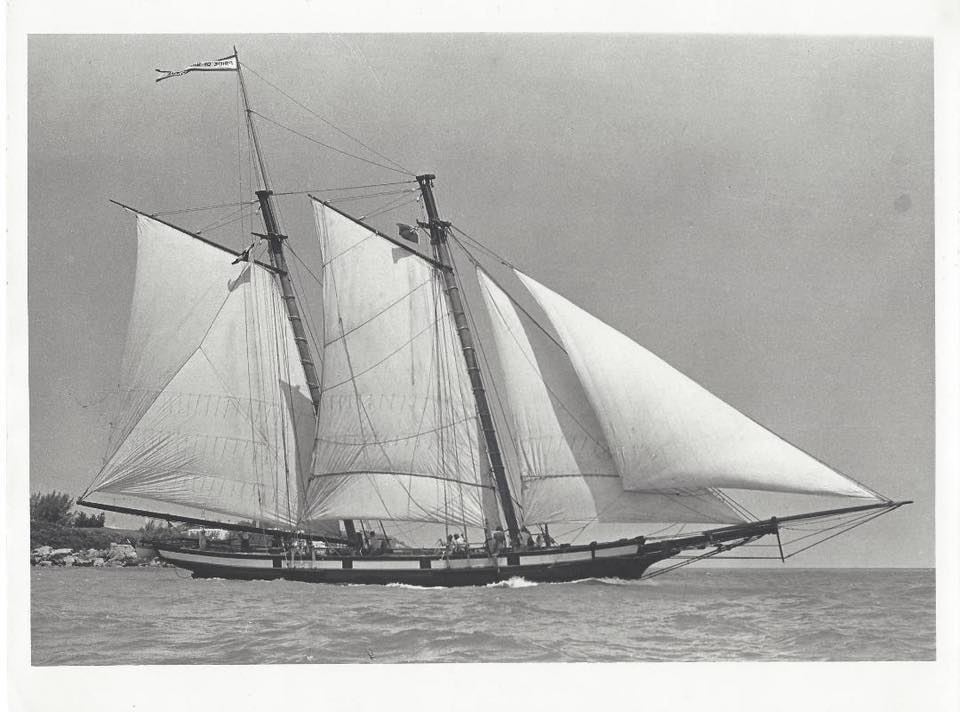
One of the perks of our 50 Years of Pride series is that we can stop and rewind to celebrate the lasting legacy of the original Pride of Baltimore and the crew who sailed her. We recently received two amazing contemporaneous first-hand accounts from two crew members who sailed the first Pride. Both of these articles were shared with us by maiden voyage crewmember John Peterlin. The first account is his own, published in the winter 1977 issue of Kings Pointer Magazine. The second account shared with us by John is from shipsmith and a member of the maiden voyage crew, Gerry Trobridge. His account was published in the September-October 1977 issue of the aminconian, a publication produced by the American Instrument Company for AMINCO employees and their families.
This pair of firsthand accounts of the maiden voyage and the adventures that followed paints a vivid picture of life aboard the first Pride. Sleeping in hammocks, low overheads below deck, and bouts of seasickness appear in both John’s and Gerry’s recollections. Together, their words remind us that while Pride herself is the vessel, it is the people who sail her who truly define the story. These firsthand perspectives allow us to tell Pride’s history through the eyes of those who walked her decks, stood watch, and carried her to ports near and far.
Catch up on past parts of our blog here.
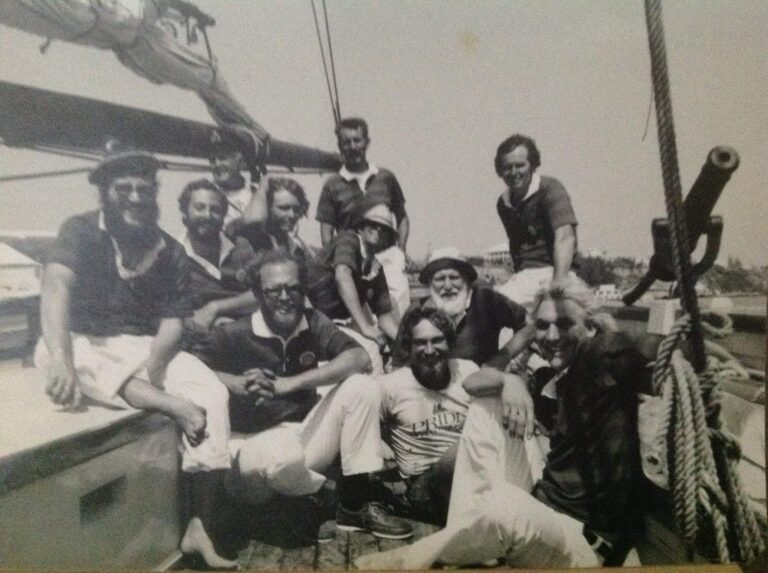
Photo: The Maiden Voyage Crew in Bermuda
(L-R): Mark D’Anci (Steward-Cook, with glasses, seated wearing tam o’ shanter), John Peterlin, Captain Melbourne Smith (wearing cap, standing in front of the main boom), Douglas Griffith (foreground), Peter Boudreau (behind Doug), Andrew Davis (with hat next to Peter), Chief Mate Charles Whitcomb (standing behind Andy Davis), Michael Kozma (seated foreground next to Doug Griffith), Gerald “Gerry” Trobridge (white beard and hat behind Mike Kozma), Michael Walsh (seated in foreground inboard of the swivel gun), and Allen Rawl (seated on the bulwark behind Gerry Trobridge)
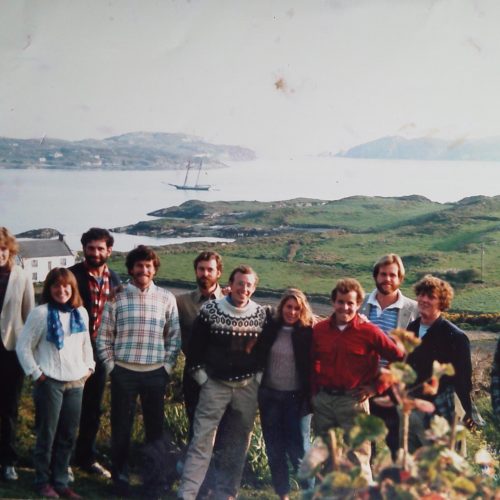
The following list represents the crew of the first Pride’s maiden voyage, many of whom also played key roles in her construction. Nine of the twelve crew members were part of the shipwright team. Melbourne Smith served as captain, with Charlie Whitcomb as chief mate. The other mate was Peter Boudreau, who, according to Gerry, performed remarkable feats of endurance while planking the hull through the winter months.
Gerry also notes that boatbuilder Andy Davis likely put more hours into Pride than anyone else, working alongside carpenter Allen Rawl. Doug Griffith contributed extensive electrical and mechanical work in addition to his woodwork. Mike “Kozmo” Kozma served as rigger, while Patrick “Pat” Smyth—who joined the project later—painted the ship and stowed ballast.
John Peterlin, Mike Walsh, and Mark D’Anci (cook) rounded out the crew. Also aboard for the maiden voyage was Kevin Weber, a cameraman documenting the ship on film.
Gerry departed the ship in Bermuda, and John would stay on for the remainder of the summer, returning to Baltimore and then proceeding on to Philadelphia, New York, Oyster Bay, Newport, New London, New Bedford, Provincetown, Boston, Halifax, Camden, and Cape May. New crew would join the ship for that first season of sailing, including (not limited to) Bob Wallace and Skip Newcomer. Also joining the ship for a portion of the voyage was Townsend Wentz.
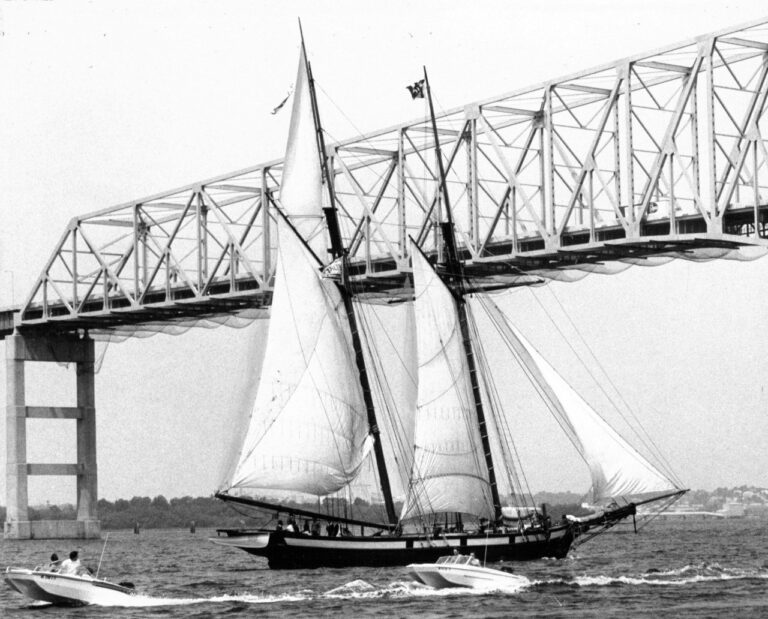
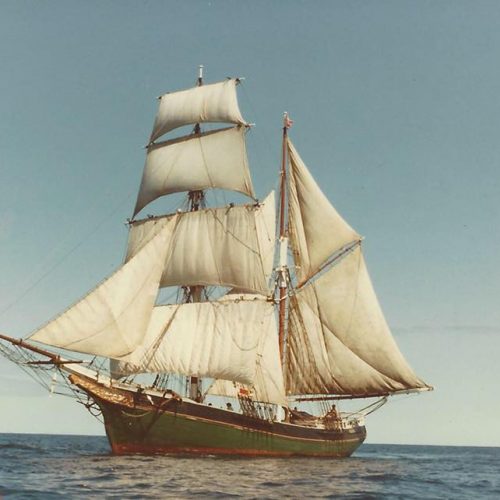
Pride sailing toward the recently opened Francis Scott Key Bridge, photographed by The Baltimore Sun as she returned to the Inner Harbor at the conclusion of her maiden voyage on June 23, 1977. (Baltimore Sun photograph by Lloyd Pearson)
n recent correspondence with John Peterlin, we learned a few interesting additional factoids. The Pride crew would later learn that a major cold-front squall that hit Pride on her maiden voyage had previously barreled through Baltimore and knocked down a container crane at Dundalk Marine Terminal. John also shared that while in Mystic Seaport, Pride was visited by sail-training pioneers Irving Johnson and Allen Villiers. John recalls the crew’s excitement at meeting Johnson, and members of the crew recounting tales his exploits and extraordinary strength and ability to perform seemingly superhuman feats in the rigging.
A most considerable fact worthy of note was that a highlight of the ship’s visit to Halifax in July 1977 was seeing the original Star Wars, which had just come out that May. John recalls the crew imitating lightsaber duels on deck after leaving Halifax.
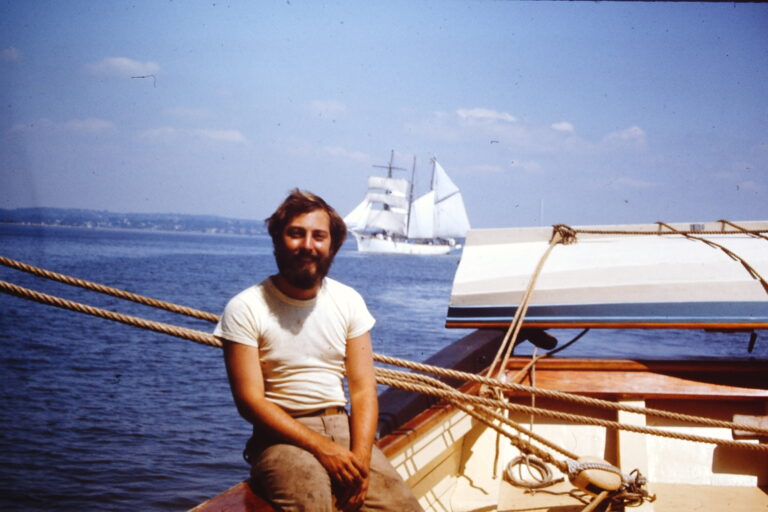
Today, John is an associate professor of the practice at the College of Marine Sciences and Maritime Studies at Texas A&M University at Galveston. John is an accomplished maritime industry executive and educator, including serving for more than 17 years in a senior leadership role at the Port of Galveston, Texas. He is a U.S. Coast Guard–licensed master mariner and graduate of the U.S. Merchant Marine Academy. He continues to be actively involved with the tall ship community. John is a lifelong supporter and friend of Pride of Baltimore, Inc., and has been of great help in telling the story of the early voyages of the first Pride, sharing photos, memories, and documents from his time aboard.
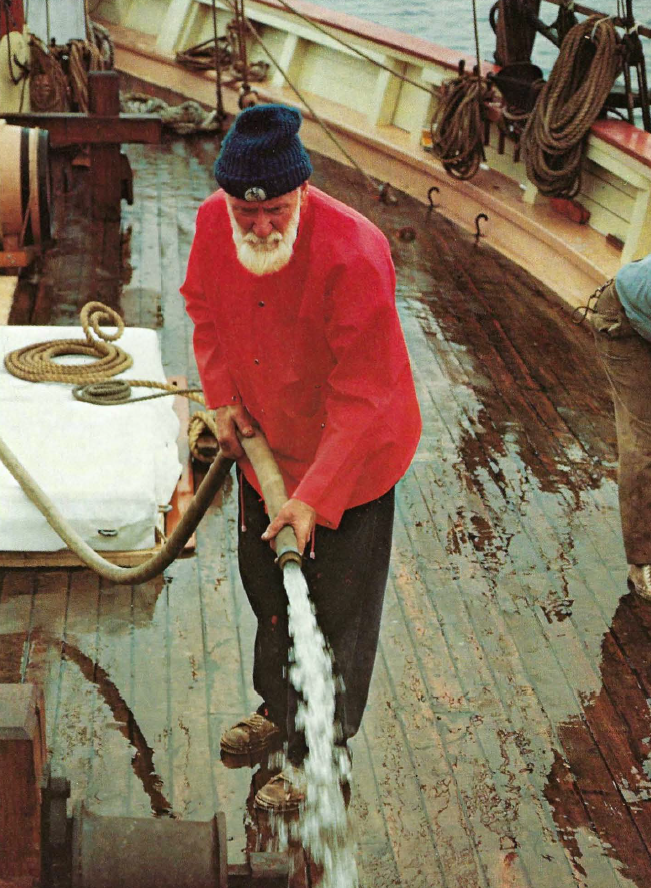
Originally from South Africa, Gerry Trobridge joined the shipwright crew as the “master blacksmith or more correctly, the master shipsmith”. He was described by Thomas Gillmer as a large man with a snow-white beard and muscular body. He was a professional electronics engineer, but left that job temporarily to work on the Pride build. Some years before Pride, he had built his own steel boat and sailed it around the world with his wife, Marie. After that voyage, he moved back to his farm west of Baltimore. According to Gillmer, the sea was always with Gerry, and that is what called him to work on Pride. Gillmer continues describing him as “A most skillful artist with metal” and that “he would forge such things as large and heavy iron-strapped pintles and gudgeons for the rudder, the channel chains for the deadeyes, cannon trunnion holds – a nearly endless variety of small and large ‘tailor-made’ fittings.” Gillmer adds that “Gerry’s good humor infiltrated all who worked with him. He was irreplaceable”. To this day, John Peterlin cherishes two iron nails from the construction of Pride and believes Gerry likely crafted them himself.
Gerry was joined on the shipwright team by his son, Tom. According to Gerry’s daughter, Tracy, Melbourne Smith used to joke that any time they needed to move a large timber, they could put “Tommy” at one end and four men on the other. A lifelong friend of Gerry’s recently shared with us that he had a love of schipperke dogs, notably Binty and Trudy.
Following the tragic loss of the first Pride of Baltimore in 1986, Gerry would lend his assistance once again as a shipsmith on the build of Pride II. Gerry passed away in April of 2009. A lifelong supporter of Pride, on his passing, in lieu of flowers, his family asked that memorial donations be made to Pride of Baltimore and USS Constellation.
I hope you are enjoying our ongoing 50 Years of Pride series. Stay tuned for part 9 next week.
Cheers,
Patrick
Special recognition to Captain John Peterlin, Tracy Trobridge, and Captain Jeanne Gail for their input and contributions used to tell this Story.
Sources:
Gillmer, Thomas C. Pride of Baltimore: The Story of the Baltimore Clippers. International Marine, Camden, ME 1992
Chisolm, Evelyn Pride of Baltimore: The Renaissance of the Baltimore Clipper. Eucalyptus Tree Studio