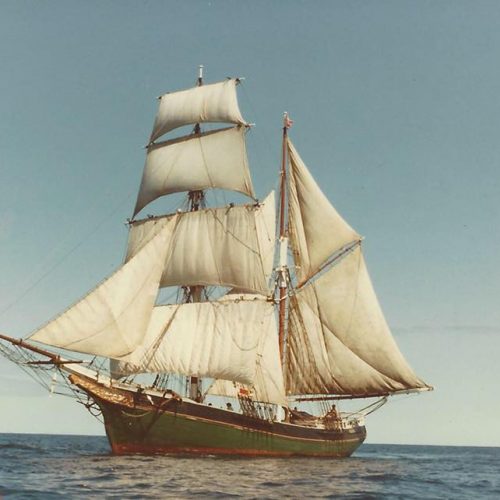
In her first years, Pride successfully performed its mission along the Atlantic and Gulf Coasts, in the Great Lakes, and in Canada and the islands of the Caribbean. And in the fall of 1982, she undertook a bold journey from the Chesapeake Bay to the Pacific, a historic trip of more than 17,000 miles. Upon completion of this voyage, since her launch, Pride will have visited every coastal state in the lower 48 of the United States of America.
In an era before social media, Pride captivated all who had a chance to see her and was featured regularly in newspapers across the country. News of Pride and her travels always found its way back home, and the people of Maryland followed her closely. This included the students of Ursula Mosely’s 5th-grade class at Church Hill Elementary in Queen Anne’s County, Maryland’s Eastern Shore. The students studied Pride in their social studies class and learned about life aboard ship, day-to-day work habits of the crew, and followed Pride‘s travels on a large map in their classroom. All along the way from Baltimore to the West Coast and back, Pride‘s Captains made weekly calls back to Maryland that were shared on a local news station as part of weekly traffic reports, giving students around the state updates from the ship and keeping Pride relevant to the people of Baltimore, no matter where in the world the ship was.
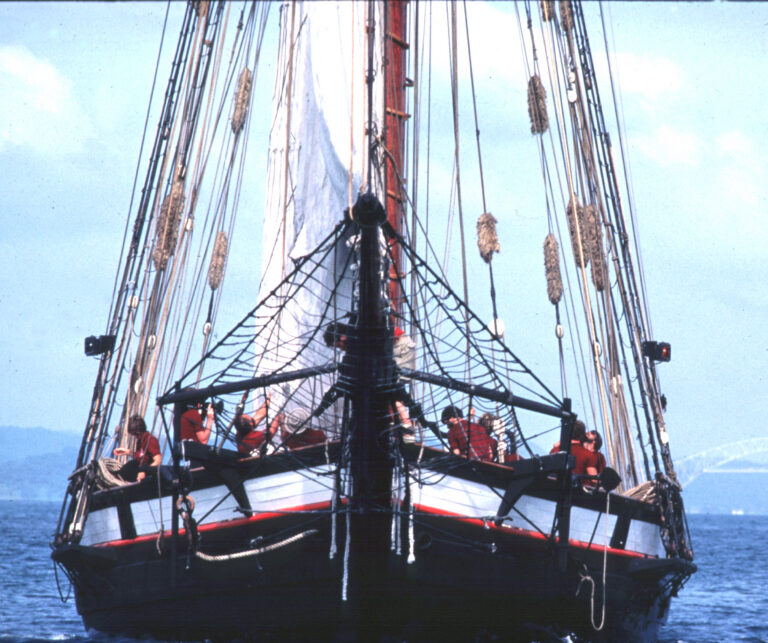
This incredible voyage would take Pride through the western North Atlantic, into the Caribbean, with a stop in Kingston, Jamaica, before heading for the Panama Canal. After passing through the canal, the ship traveled up the central American West Coast, making stops along the way. On February 1, 1983, the ship sailed past California’s Point Loma and was escorted into San Diego by a charter schooner, two America’s Cup defenders, and a host of US Naval vessels.
Heading north from San Diego, battling the typically tempestuous conditions of the West Coast at that time of year, Pride of Baltimore drew attention in ports along the way, with local papers running headlines such as “From Baltimore, with pride.” The Los Angeles Herald Examiner covered the ship’s early March 1983 visit to Los Angeles, noting that its timing was “as bad as that of Queen Elizabeth’s yacht, the Britannia.” Still, Pride of Baltimore defied the seas and arrived on schedule. The visit was made all the more noteworthy by the presence of Baltimore Mayor William Donald Schaefer and Maryland Lieutenant Governor Joseph Curran, whose aim was to promote Maryland and encourage California businesses to expand eastward.
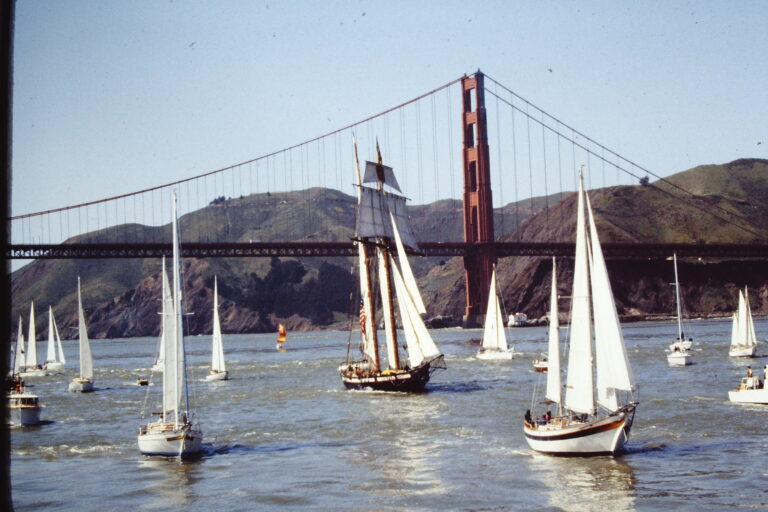
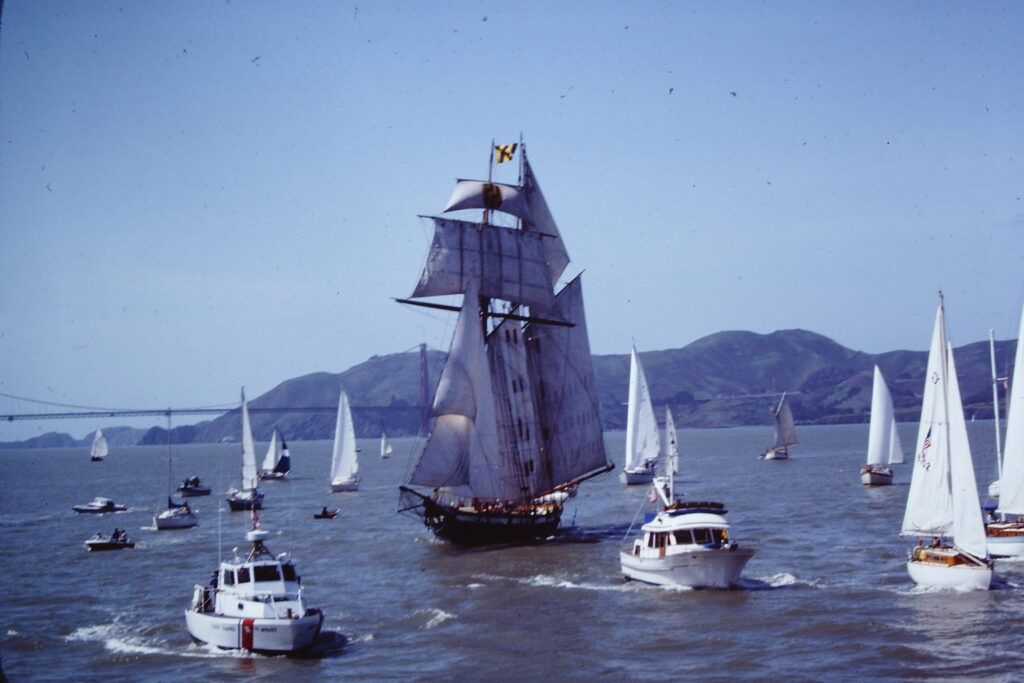
On March 3, Pride approached San Francisco. Captain Armin Elsaesser describes it in his log:
1204 hours
Wind is light westerly, maximum flood, bright, clear weather, Pride is under all sail. A fleet of vessels fills our immediate horizon. Ahead, a fireboat shoots out plumes of water in welcome. Horns blare, sailors shout their greetings. All our cannons blast in unison and the deafening thunder echoes from that most famous orange-red span, our destination, the Golden Gate Bridge.
A moment of unbelievable, thrilling tension and relief, 6,000 miles. 22 ports. We’ve made it!
Baltimore to San Francisco. All that we have accomplished crystallized in that moment. The ship and her crew were indistinguishable. We had made history. We had proceeded beyond a question that Pride could work for us and her proud city.
Upon arrival at the Golden Gate Bridge, Pride crew member Leroy Surosky opened celebratory cans of National Bohemian beer, cases of which had been donated to the ship by a Baltimore brewery.
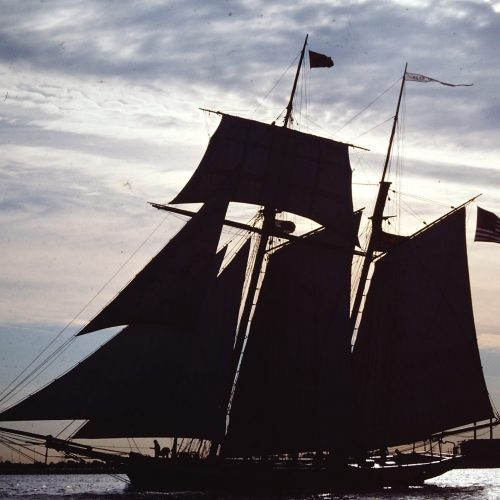
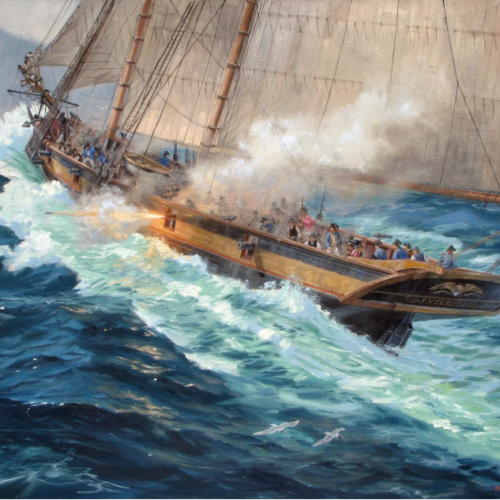
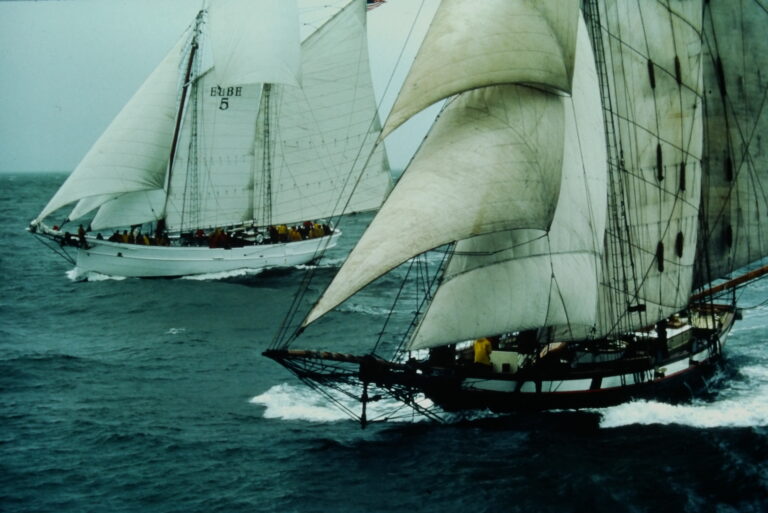
In late April 1983, Captain Elsaesser and the crew who had brought Pride of Baltimore to the West Coast were relieved by Captain Jan Miles and a fresh crew flown in from Baltimore. It was at this point in the voyage that one of Pride of Baltimore’s most legendary and oft-retold episodes unfolded. Upon assuming command, Captain Miles learned that Armin had arranged for two storied vessels to sail together. On May 5, Pride of Baltimore engaged in a “gentleman’s race” with Wander Bird, owned by Harold Sommer of Sausalito. Built in 1883 in Hamburg, Germany, as Elbe No. 5, Wander Bird was an authentic German pilot schooner, making the encounter a rare meeting of historic sail brought vividly to life.
The term “gentleman’s race,” which dates back to the 19th century, had nothing to do with the makeup of the crew. In fact, Pride sailed with a mixed-gender crew that included a number of women. Rather, it described the spirit of the event itself. Before the race, Captain Miles took a ferry to Sausalito to meet with Sommer, and they came up with a simple plan: no official start, just a rendezvous; no official turning mark; and no official finish line. Seamanship and sportsmanship, not competition, were the point.
The following race description is paraphrased from Captain Jan Miles’s report on the race. You can read the full account of the race in Sailing with Pride by Greg Pease.
Race day was messy with lots of rain and mist, along with a strong breeze. Pride was ready to go at the appointed time and designated rendezvous. But Wander Bird would not be able to get to the rendezvous for some time, as the wind and current were foul. So Pride went half her way, and as the vessels neared, Wander Bird came about and the race was on – heading out to the Gate on a close port tack.
Both boats showed great speed and similar speed. Pride was sailed with more wind and sail than any had experienced in the crew. According to Captain Miles, “Pride was at no time being overpowered. Sailed hard—but not overpowered. An important experience for all to have as it tells us more about the dynamics of this very rare type of vessel.” Both vessels cleared the Gate and when they were just west of Point Bonita the dueling schooners came about.
The run east into the Bay was fast, and both vessels showed equal speed. Pride got back through the Gate first with “the Bird” close behind. In the on-again, off-again puffy conditions, Wander Bird got ahead of Pride. The vessels coordinated over the radio and the race was concluded; both vessels arrived off Sausalito Beach within less than a boat’s length of each other. In his log, Captain Miles noted, “Both boats sailed closely together, giving the illusion of a very close race. In reality, it was a “gentlemen’s race” that had the quality of showing off both boats at their best and educating all on the differences of type and design—especially era. Godspeed to all involved on both boats”.
The two schooners would race again on August 31 as Pride passed through the Bay Area on her way south. Newspapers from Essex, Connecticut, to Palm Springs, California, to Anchorage, Alaska, would share images from this second meeting, promoting it as an East Coast vs. West Coast match-up, and naming Wander Bird the victor. The local media seems to have been out of the loop on the gentleman’s aspect of the two vessels sailing together.
After San Francisco, Pride would continue north to Oregon, Washington, and British Columbia with a stop in Vancouver. Vancouver marked the furthest point of Pride’s journey on the West Coast, 230 days and 8,000 miles from Baltimore. “A three-gun salute welcomes Pride into English Channel … Pride has won the hearts of our Canadian neighbors” – Captain Jan Miles
After Vancouver, Pride would begin her voyage south, with an eye on hurricane season in the eastern Pacific. Captain Miles would plan for additional port stops along the West Coast, notably including a second visit to San Francisco, followed by excursions up the Sacramento River to Old Sacramento and up the San Joaquin River to Stockton.
On her way home Pride made a second visit to San Diego. By invitation of Melbourne Smith, Pride‘s crew received a tour of California’s flagship, the revenue cutter Californian, which was under construction at the time. Captain Miles recalls receiving a personal tour of the shipyard at Spanish Landing in San Diego Bay.
At the end of September 1983, Pride departed San Diego and turned toward home. She returned to Baltimore on November 19 and was met by thousands lined up along the shore of the Inner Harbor. Among those crowds of people were over 100 students from Church Hill Elementary, including Ms. Ursula Mosely.
I hope you are enjoying our ongoing 50 Years of Pride series. Stay tuned for part 12 next week.
Cheers,
Patrick
Photo credit:
1. Featured photo – Williams
2. Crew on foredeck, credit Greg Pease
3. Arriving in San Francisco, Williams
4. Pride and Wander Bird, Unknown
Bibliography:
Pease, Greg. Sailing with Pride. Baltimore: CA Baumgartner Publishing, 1990.
Waldron, Tom. Pride of the Sea. New York: Citadel Press, Kensington Publishing Corp., 2004.
Desert Sun (Palm Springs, California), September 1, 1983.
Queen Anne’s Record Observer (Centreville, Maryland), December 7, 1983.
Los Angeles Herald Examiner (Los Angeles, California), March 3, 1983.
Sacramento Union (Sacramento, California), August 11, 1983.