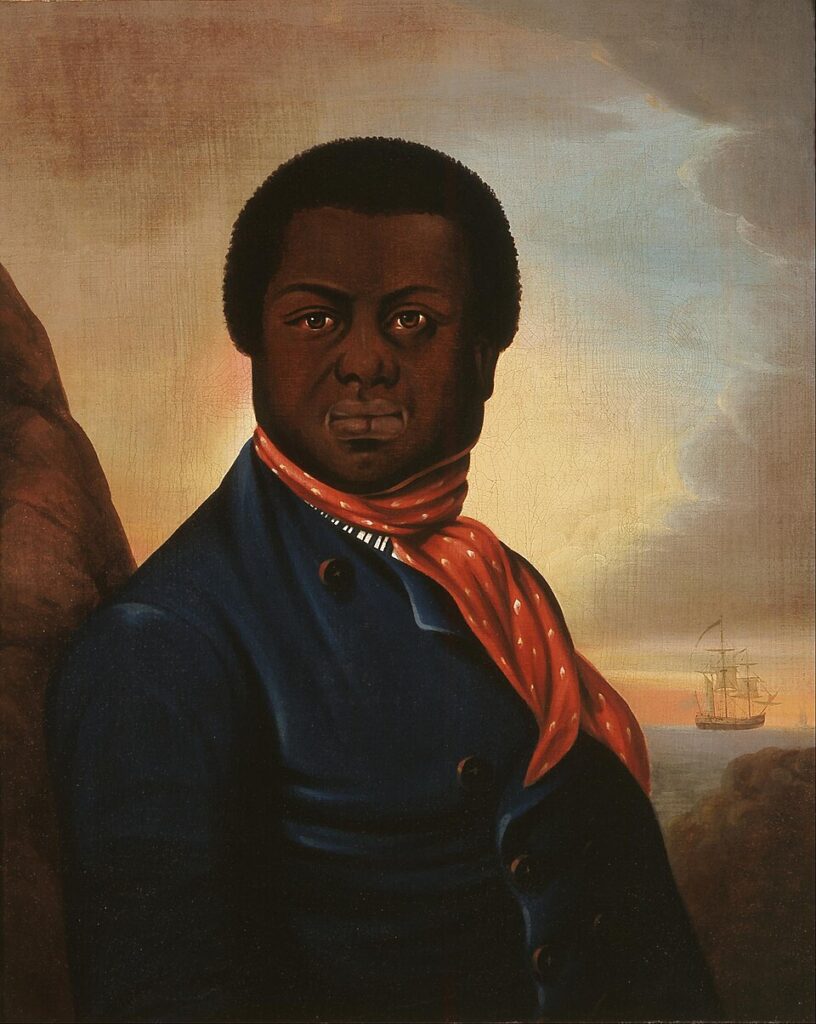
The history of Black sailors in the Atlantic world is complex. The sea was never free from exploitation or danger, yet maritime labor placed Black and white seamen within the same occupational culture. As Jeffrey Bolster writes in Black Jacks: African American Seamen in the Age of Sail, the customs and appearance of sailors “stamped them indelibly as members of the seafaring fraternity.”
One of the most visible markers of that fraternity was dress.
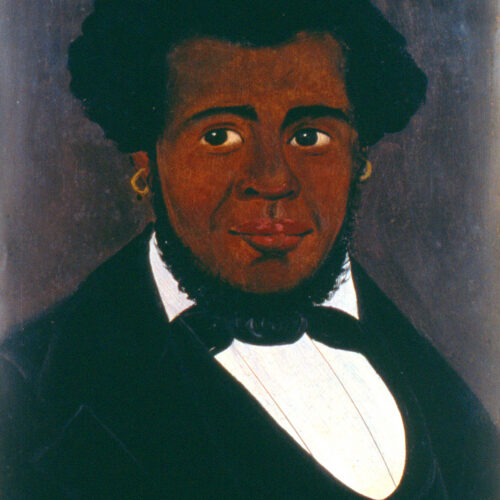
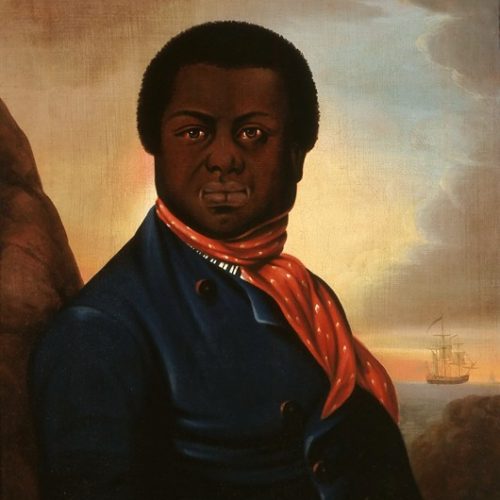
“Blacks were often qualified for every station onboard ship, but few were allowed to command. As the master of the whaler Industry in 1822, Captain Absalom Boston was quite the exception. He sat for his portrait in gold hoop earrings and a white shirt and tie, revealing a man comfortable with several identities and conscious of his status” — Jeffrey Bolster, Black Jacks
Image: Boston, Absalom F. Portrait of Captain Absalom F. Boston. Ca. 1835. Oil on board. Accession no. 1906.0056.001. Nantucket Historical Association.
In the late eighteenth century through the early nineteenth century, a working sailor’s kit was both practical and distinctive. Historian Matthew Brenckle notes that “sailors certainly put a great deal of effort into looking like seamen. Their clothes embodied the skills and knowledge of their profession, and signified they were ‘part of the club,’” adding that “without his jacket and trousers, the sailor seemed to lose a bit of himself.”
Wide, loose trousers were worn high at the waist and cut short above the ankle to reduce the risk of soaking fabric while working wet decks. These were often made of wool or white duck linen, depending on season and climate. Jackets were typically short, as long coat tails were impractical aboard ship. “Fearnought” jackets and early pea coats made of heavy wool were common choices, offering warmth and durability without excess length.
An important distinction should be made between naval and merchant seamen. Sailors in the United States Navy were issued standardized clothing that included trousers, handkerchiefs worn at the neck, outside jackets, underjackets with sleeves, vests, drawers, round hats, shirts, shoes, and stockings. Merchant sailors were not issued uniforms, yet they often dressed in remarkably similar fashion. Occupational identity, more than regulation, shaped appearance.
Hair was often worn long and tied back or braided. Both Black and white sailors adopted similar styles. Earrings also appear in contemporary descriptions of seamen, though their prevalence varied by region and era.
Tattooing offers perhaps the clearest example of a shared occupational identity. The word “tattoo” derives from Polynesian languages, and the practice expanded among European and American sailors after Captain James Cook’s Pacific voyages beginning in 1769. Sailors who traveled to the Pacific returned with Polynesian designs, though maritime tattooing predated Cook. As early as 1708, Ned Ward described shipboard artists pricking designs such as the Jerusalem Cross into their shipmates’ skin and rubbing in pigment.
Bolster notes that most tattooed Black sailors bore the same designs as their white shipmates: initials, anchors, mermaids, dolphins, and crucifixes. Michael Jones, an African American born in Louisiana in 1774, had a figure representing “Justice” tattooed on his body. Another Black sailor, Thomas Lane, wore an eagle and stars on his palm.
It is important not to overstate their prevalence. Most sailors were not tattooed. Yet in a sample of 846 American seamen who applied for protection certificates between 1796 and 1803, 21 percent bore tattoos. In an era when tattoos were rarely seen outside maritime culture, they signaled occupational belonging. As Bolster observes, they spoke to “an occupational identity not dependent on race.”
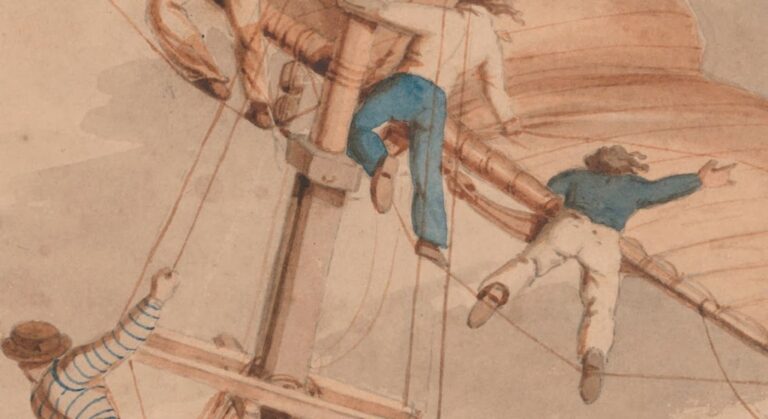
A detail from an 1830s watercolor of sailors balancing on a foot rope. All wear shoes. [USS Constitution Museum Collection, 2112.1]
Footwear presents another revealing detail. Popular imagery often depicts sailors barefoot in the rigging. While men certainly worked barefoot at times, especially when washing decks, evidence suggests that sailors valued sturdy footwear. Dr. William Barton of the early United States Navy instructed that sailors remove their shoes and stockings before washing decks, implying that they normally wore them. Merchants supplied “strong boots” and “seamen’s boots” to naval pursers in the early nineteenth century, though cost likely limited universal access. Boots were practical but not inexpensive.
Taken together, clothing, hair, tattoos, and footwear marked sailors as members of a distinct working community. For Black and white seamen alike, dress was not merely fashion. It was functional, professional, and symbolic. It identified them as men of the sea — part of a fraternity shaped by labor and shared experience.