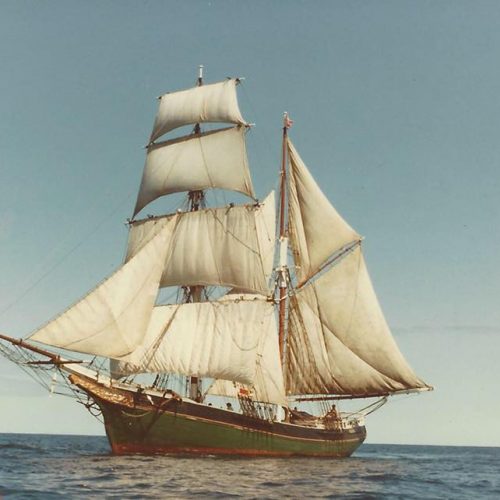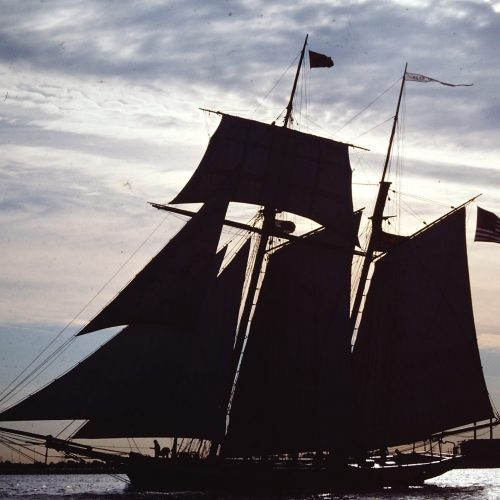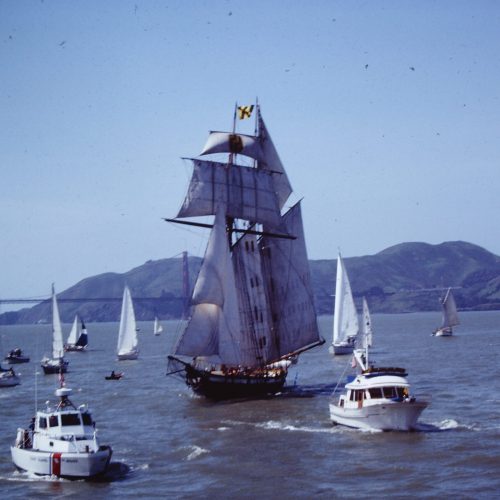
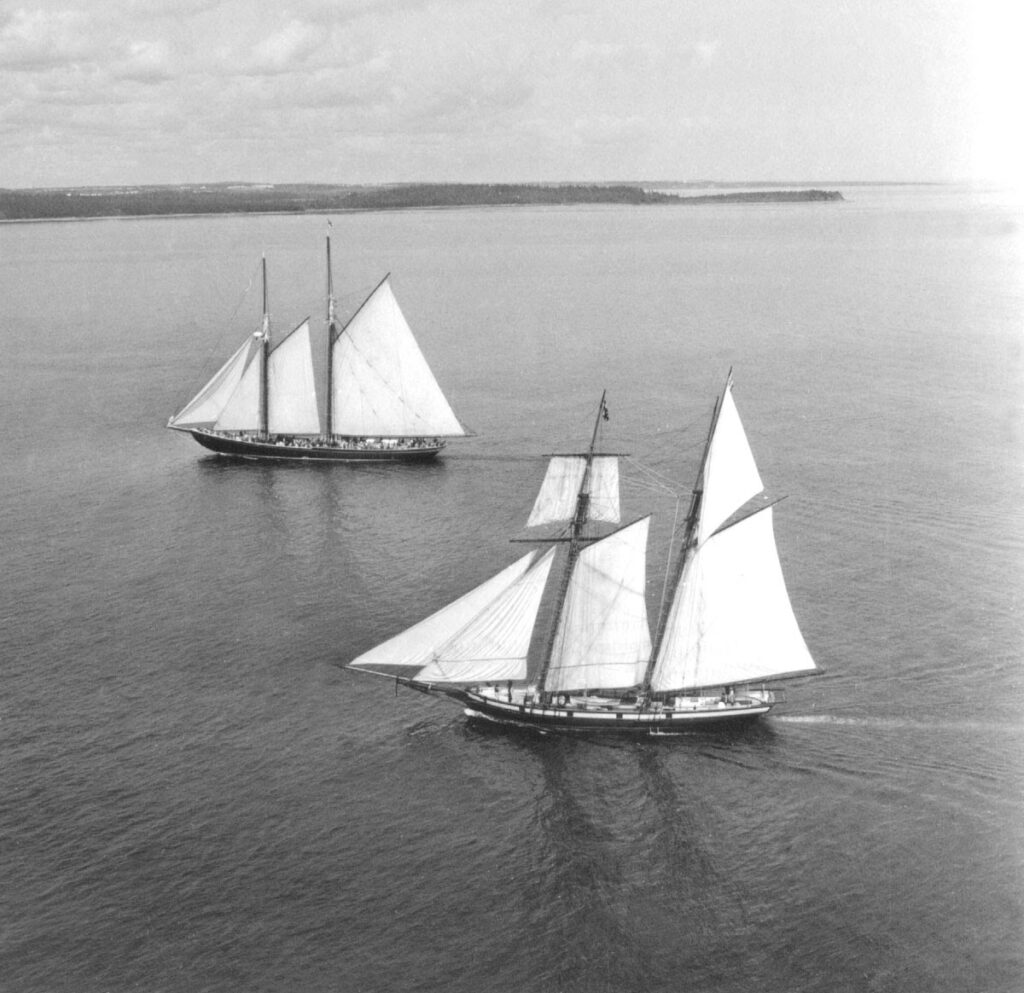
At her commissioning, Pride of Baltimore was charged by Mayor William Donald Schaefer with a clear mission: to sail widely and share the spirit of Baltimore wherever she went. From the outset, she fulfilled that charge. During her inaugural season, Pride visited Bermuda and ports along the East Coast of the United States and Canada and met many renowned vessels along the way, including her first dance with Bluenose II. She also competed in her first American Sail Training Association race from Oyster Bay to Newport. Pride of Baltimore II remains a member vessel of Tall Ships America, beginning a relationship of partnership and collaboration that continues today.
Right out of the gate, Pride captured the public imagination. The energy surrounding her launch and early voyages traveled with her from port to port, carried by word of mouth and press coverage alike. Newspapers across the country took notice, including the Bozeman Daily Chronicle in Montana, which ran a feature under the headline “Baltimore Promotes Its Pride.” The article highlighting the ship’s visit to Mobile, Alabama, described the ship’s purpose as “to sail the waters of North America,” noting that she did so “as effortlessly as any shapely lady in black,” calling attention to “the rightful pride of every Baltimorean, the new look of their harbor and their dockside.” Even far from the waters she sailed, Pride had become a symbol of a city reclaiming and sharing its maritime identity.
That momentum shaped Pride’s earliest years under sail. From the Chesapeake, she ranged down the East Coast to ports including Wilmington, Charleston, Savannah, Jacksonville, and Miami, before rounding Key West into the Gulf to visit Tampa and New Orleans. Her voyages in the first years of her life extended into the Caribbean as well, with calls including Puerto Rico, the Virgin Islands, St. Lucia, Trinidad, Martinique, Aruba, and Barbados (just to name a few).
At home in Baltimore, that same enthusiasm helped fuel the growth of an annual Maritime Heritage Festival. The story of Pride of Baltimore unfolded alongside the city’s broader vision for a revitalized Inner Harbor, and the two became closely intertwined. In its second year in 1978, the festival welcomed 60 visiting ships and offered day sails aboard vessels like Western Union. Visitors enjoyed deck tours aboard Pride and Gazela, along with crab feasts, dancing, and movies projected onto Pride’s sails. During this period, Pride of Baltimore served as a flagship for Baltimore’s emerging waterfront renaissance, sharing the spotlight with institutions such as the Maryland Science Center, and the future National Aquarium and Inner Harbor pavilions.
In the summer of 1979, Pride turned north once more, sailing to Halifax before continuing up the St. Lawrence River to Quebec, Rochester, and Toronto. Newspaper clippings from these early years consistently celebrate the vessel’s arrival. At each stop, the ship welcomed the public aboard and hosted receptions for Baltimore firms. Wherever she sailed, Pride made headlines, and word of her travels always found its way back home.
The spring/summer of 1981 is worthy of note. Following a winter spent in the Caribbean, Pride made a grand return home to Baltimore and a Pride of Baltimore Festival was hosted to celebrate. The two day event was described as featuring “continuous entertainment” featuring school marching bands, student-made artwork, a visiting US Navy destroyer, live music and more. Looking ahead that summer, Pride would return to the Great Lakes. In late May, command passed to a 31-year-old captain from Annapolis, Captain Jan C. Miles, thus ushering in a new chapter in the ship’s evolving story.
A review of our records underscores the extraordinary scope of these early years. Between her maiden voyage in May 1977 and her voyage to the West Coast in 1983, Pride of Baltimore visited more than 110 ports of call. These ranged from nearby Chesapeake ports such as Annapolis, Oxford, and Cambridge to destinations throughout the Great Lakes, Caribbean, and Gulf, all while serving as a floating ambassador for Baltimore.