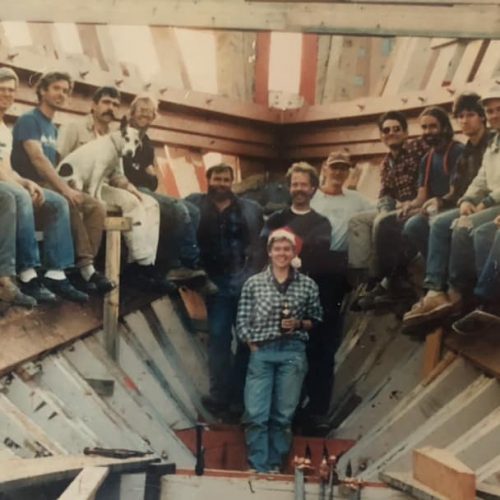
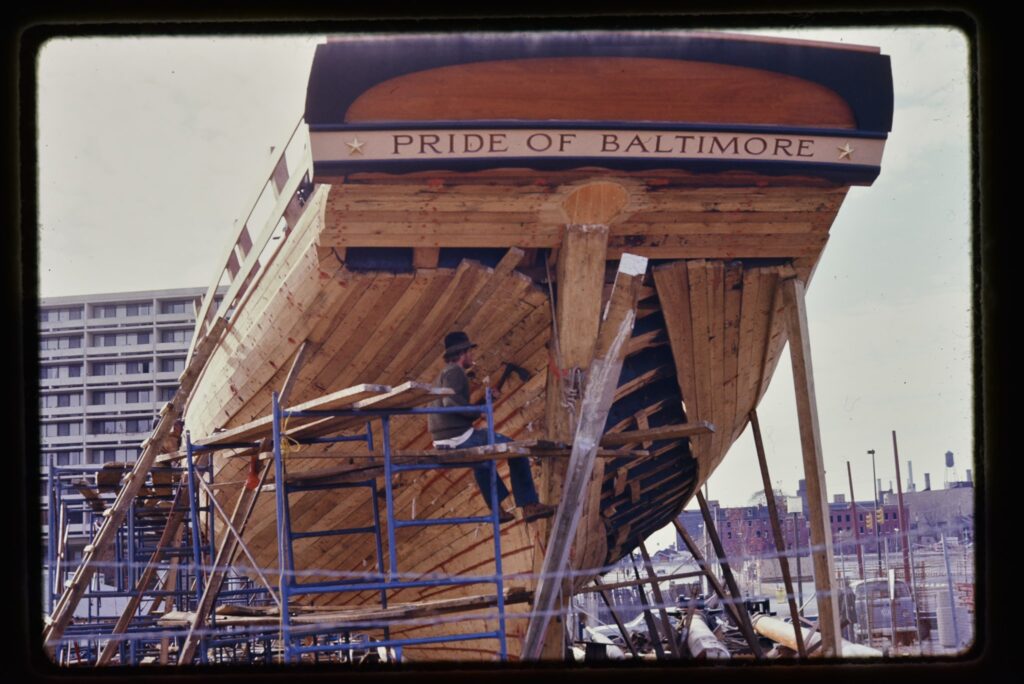
Photo: Peter Boudreau fairing planks during the build of Pride. Photo courtesy of Michael Szrom
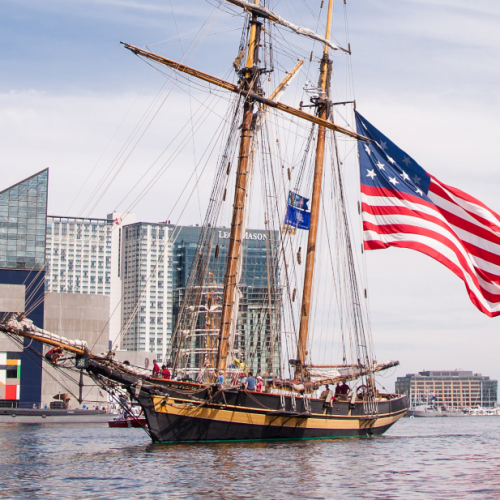
Pride of Baltimore is, at its heart, a story of people. From the Mayor who supported the idea, to the citizens who stood behind it, to the builders who shaped every timber, and the crew who sailed her. Many of you remember visiting the open-air shipyard on the shore of Baltimore’s transforming Inner Harbor and watching a vessel take shape. Without the people, there is no ship.
We’d like to share just a few of the individuals who helped bring her into being. Much of what follows comes from Thomas Gillmer’s book Pride of Baltimore: The Story of the Baltimore Clippers and Tom Waldron’s book Pride of the Sea.
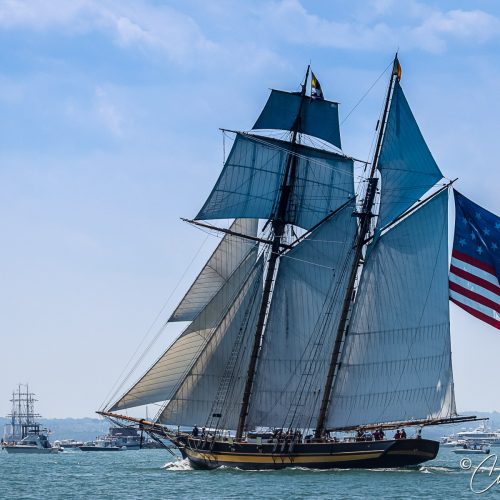
A notable figure in the Pride of Baltimore story is Melbourne Smith (1931-2018), a marine artist, historian, and shipbuilder. Smith founded the International Historical Watercraft Society. Melbourne helped conceptualize, design, and construct Pride of Baltimore — the first Baltimore Clipper to be built in 150 years.
He also served as the first captain of the new “working ambassador for Baltimore and the Port” during her maiden voyage in the summer of 1977. Smith’s impact on American maritime history extended beyond Baltimore. He contributed to the design & construction of several notable tall ships, including Californian, Lynx, and Niagara.
Working with him was naval architect Thomas C. Gillmer (1911-2009), a retired U.S. Navy officer and longtime professor at the U.S. Naval Academy. Gillmer was a leading authority on historic American sailing craft and authored several texts on naval architecture, including studies on the evolution of the Baltimore Clippers. His research into these early nineteenth-century vessels informed the lines of Pride of Baltimore, ensuring she reflected the history she was built to represent. His design work provided the foundation for the ship that became Maryland’s ambassador on the water.
In his book, Pride of Baltimore: The Story of the Baltimore Clippers, Gillmer notes that many hands shaped the vessel, but he takes a moment to highlight a few of the thirty-two builders whose work stood out to him. While it isn’t possible to capture every story, we’re sharing the individuals he chose to mention. We’ve also taken the liberty of including Fred Hecklinger, whose passing in 2020 was a significant loss to Maryland’s sailing community and the region’s traditional vessels.
Simeon Young, an associate and business partner of Melbourne Smith from his time in Central America. Gillmer describes him as a master craftsman. Young came up from Belize along with four carpenters from Central America and the Caribbean.
Gerry Trobridge, the master shipsmith, was noted for a remarkable range of talent. Before the Pride project, he built his own steel boat and sailed it around the world with his wife. Gillmer highlights his sense of humor and describes him as “irreplaceable.”
Peter Boudreau, central to the story of Pride and Pride of Baltimore II. Described by Gillmer as “a fine looking lad,” he joined the build team at not “more than 19 years of age.”
“Mr. Jerome,” a retired vice president of a bank in Baltimore. His official title was “gatekeeper and accountant,” but he contributed far more. He was a storyteller, a morale booster, and someone who often guided the team to hard-to-find supplies or the right people to speak with.
Michael Kozma, noted by Gillmer as “naturally adept in all manner of sea craft and rigging.”
Andrew Davis, recognized by Gillmer for his dedication, quality of work, and growing skill. After Pride was completed, he directed the building of Spirit of Massachusetts and later earned a master’s degree in naval architecture from UC Berkeley.
Fred Hecklinger, a Baltimore native and yard foreman during the construction of Pride. He later commanded the vessel briefly. Hecklinger was a founding member of Eastport Yacht Club and is remembered as a notable figure in the Chesapeake yachting community.
Shipwrights:
Jerome G. Batzer
Geoffrey M. Beck
G. Peter Boudreau
Joseph Cox
John Cunningham
Andrew Davis
Charles Floyd
Walter Greene
Douglas C. Griffith
John A. Hafner
Robert Halley
Japheth Hazell
Frederick Hecklinger
William James
Michael Kozma
Dennis R. Livingston
Robert E. Luke
David N. McKim
John Osterburg
Michael Peacock
Allen C. Rawl
Aguileo Sandoval
Philip J. Scalia
Patrick Smyth
Gerald Trobridge
Thomas G. Trobridge
Ira A. Vanterpool
James A. Wagner
Charles Whitcomb
Joseph Young
Simeon Young
Michael Yuhasz