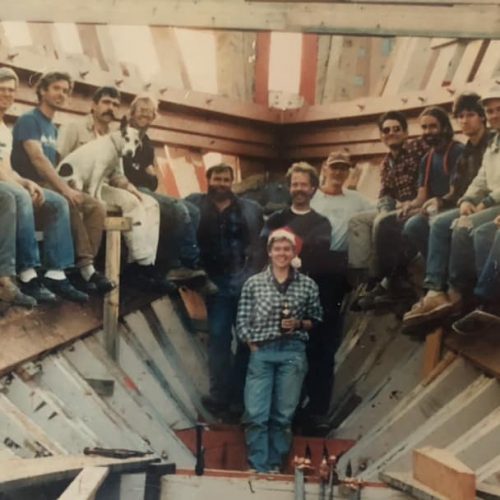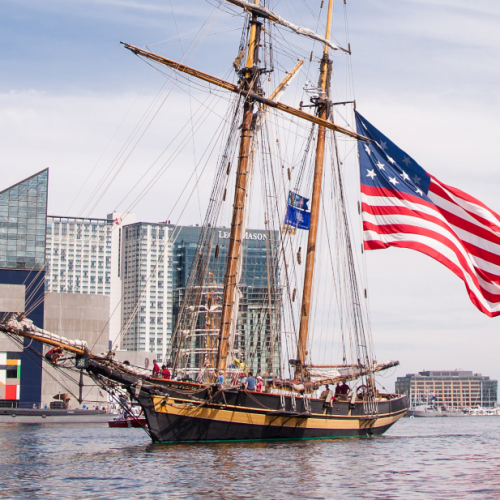
With the name settled on as Pride of Baltimore, construction moved swiftly. By December 1976, the hull was completely planked, the deck laid, and the hatches framed. In those months, the ship had truly come to life. The hull was caulked with cotton and oakum, and the seams payed with a mix of hot pitch and thickening. Her topsides were painted black, with green antifouling paint below the waterline. A broad white stripe ran along the exterior bulwark, with a narrow red stripe on the outboard edge of the covering board. The seams of her pitch pine deck were filled with pitch, and her caprail varnished. By winter’s end, Pride was ready to meet the water.
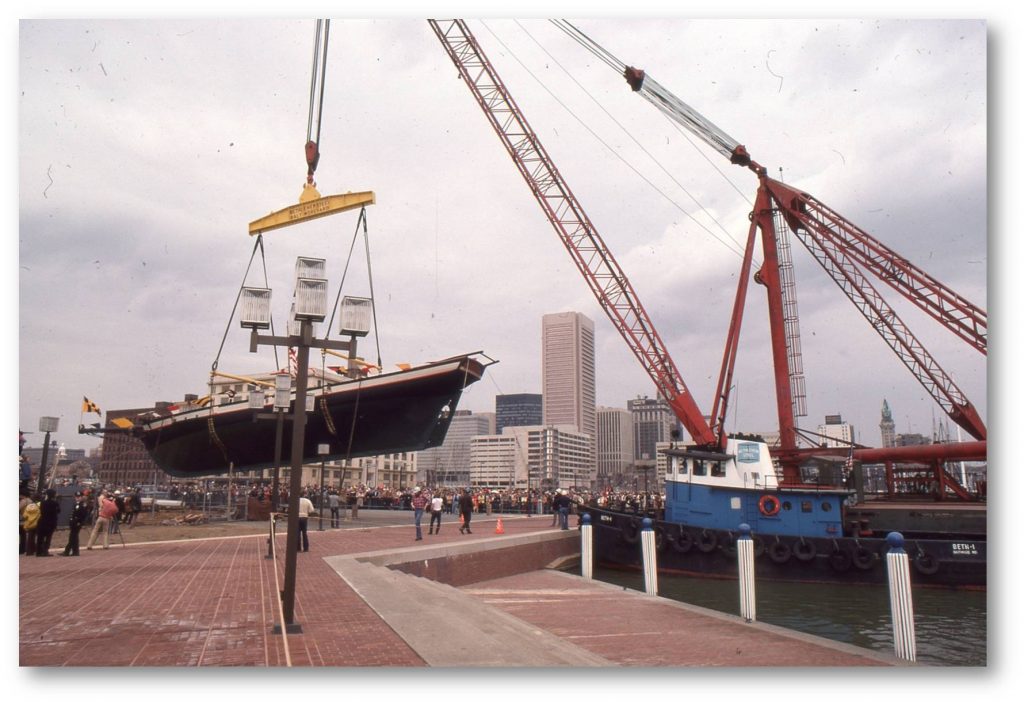
Construction on Pride had begun in April 1976, and in just under eleven months, she was ready for the water. On February 27, 1977, Baltimore gathered to witness the moment she left the yard and officially entered the harbor.
By accounts from Gillmer in Pride of Baltimore, it was a cold, damp, and overcast day, the kind of late-winter weather that settles deep into the bones. Still, the turnout was remarkable. Thousands gathered to see the launch. The Mayor was on hand to commend her, and Congresswoman Barbara A. Mikulski was there to christen the vessel.
Pride was lifted from the shipyard by the 200-ton Bethlehem Steel floating crane “Big Red,” a massive floating crane, the largest on the Chesapeake Bay. Years later, the same crane would be used to launch Lady Maryland and Pride II, cementing its place in Bay history. In keeping with tradition, a bottle of champagne was cracked against Pride’s hull by Congresswoman Mikulski, who would later go on to serve as a United States Senator.
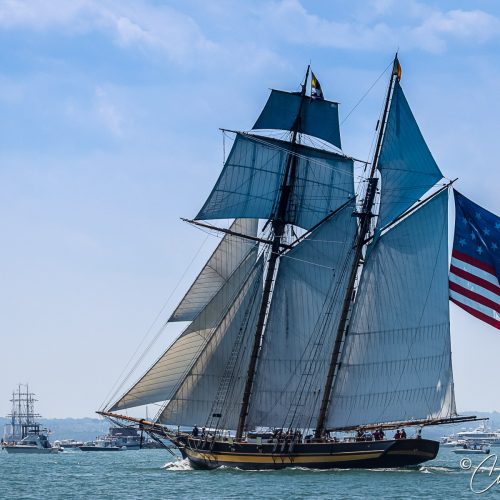
The work, however, was not yet finished. Rigging, ballasting, and final outfitting would take another eight weeks. On May 1, Pride was officially commissioned by William Donald Schaefer. As she got underway, horns tooted, bells rang, and a salute was fired from Constellation. Passing Fort McHenry, Pride dipped her ensign in respect before continuing down the Bay, at last beginning her life under sail.
Next time, we’ll follow Pride on her first voyage and early days at sea. Until then, stay tuned!
Nautical Trivia: You might be wondering what it means to “pay the seams”—it’s not a typo. The phrase refers to caulking the seams between planks on a ship’s deck or hull to make them watertight. One suggested origin of the phrase “the devil to pay” comes from this practice. In maritime usage, a particularly difficult seam to caulk, often described as the seam between the hull planking & the keel, was sometimes called “the devil.” Because this seam was typically the longest & hardest to access, paying it was considered an especially challenging task. Today, the expression “you’ll have the devil to pay” is commonly used to mean facing a very difficult job.
|
|
|---|
| In May 2025, Pride’s crew carefully downrigged the Pride Memorial and transported the yards, gaff, mast, and topmast to our maintenance facility for restoration. Once fully restored, the Memorial will return to its home in the newly reimagined park—and will be rededicated in honor of the 40th anniversary of the loss of the first Pride of Baltimore. |
|---|