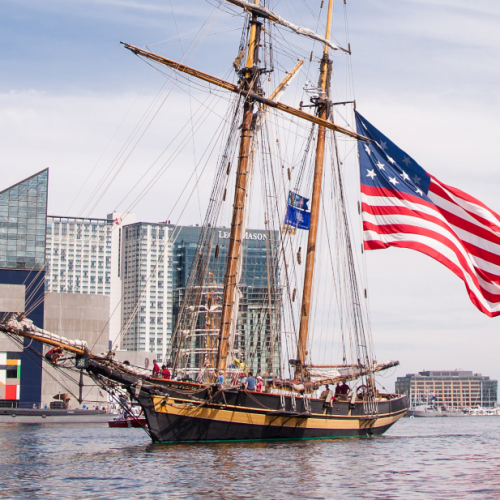
As part of our ongoing 50 Years of Pride series, we’ve been revisiting the remarkable story of Pride of Baltimore, tracing her launch, her growing reputation, and the many ways she quickly captured the imagination of people at home and abroad.
On May 14, 1986, Pride was tragically struck by a microburst squall while sailing home to Baltimore. Four crew members were lost: Captain Armin Elsaesser, Vincent Lazzaro, Barry Duckworth, and Nina Schack.
In the following blog, we will take a moment to retell the events of the days, weeks, and months that followed. Information for this blog was pulled from newspapers and magazines, as well as from Tom Waldron’s book, Pride of the Sea. In addition, we will be referencing letters, cards, and telegrams sent to Pride of Baltimore, Inc. following the loss of the original Pride of Baltimore.
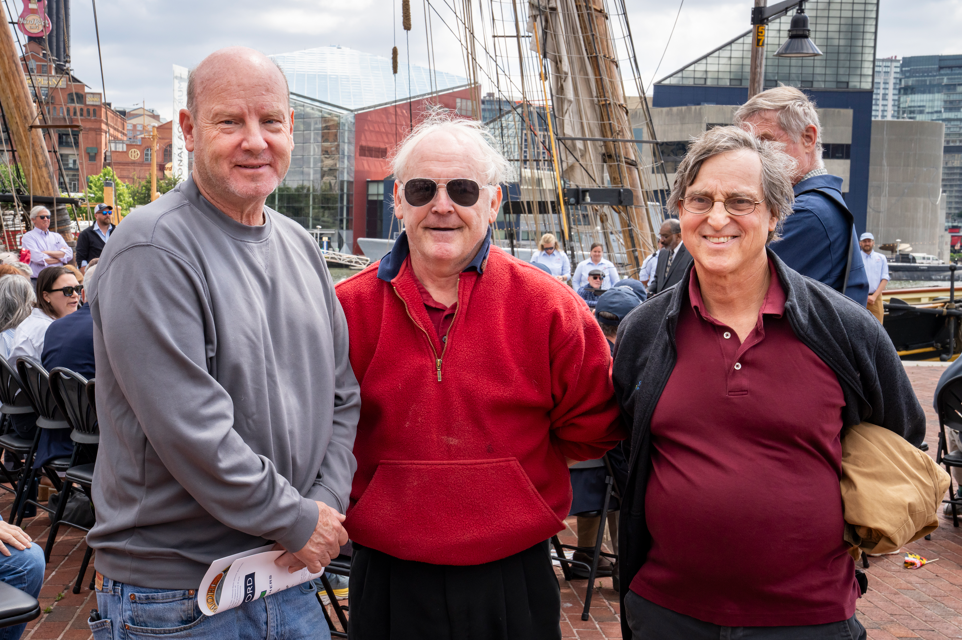
Before we dive into this week’s blog, earlier this month, on May 14, we gathered along the shore of the Inner Harbor beside Pride of Baltimore II to honor the past, celebrate the present, and look toward the future.
Together, we remembered the crew members lost aboard the original Pride of Baltimore forty years ago, reflected on the vision that launched the Pride program fifty years ago, and recommitted ourselves to carrying Maryland’s maritime story forward as America approaches its 250th anniversary.
Thank you to everyone who joined us, including former staff, crew, and family members connected to Pride and Pride II, elected officials, community leaders, supporters, volunteers, and friends of the ship. Your presence made this day deeply meaningful.
We also extend our sincere gratitude to our event sponsors and partners whose support helps make both this ceremony and the ongoing mission of Pride of Baltimore II possible: Whiteford, Taylor & Preston, The Vane Brothers Company, The General Ship Repair Corporation, and Brigantine Romance.
A special thank you as well to the Fort McHenry Guard and Fife and Drum Corps for helping connect the ceremony to the spirit and history that inspired Pride from the very beginning.
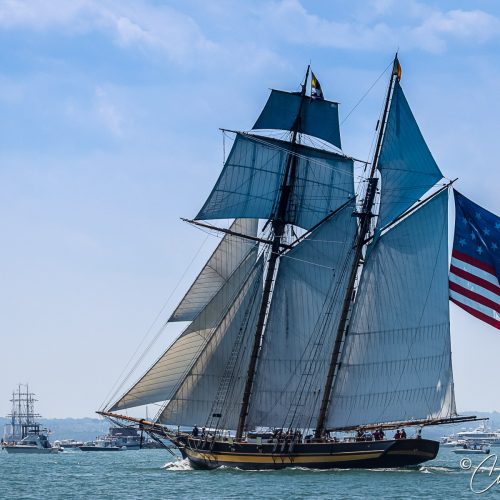
For nearly four decades, Pride of Baltimore II has served as Maryland’s sailing ambassador, carrying our history, craftsmanship, and spirit to ports around the world. This rededication was not only about a ship, but about the enduring mission behind her, and the next generation who will continue to sail, preserve, and share this story for years to come.
Thank you for being part of a most important day.
After the sinking, the eight surviving crew members spent four days and seven hours adrift at sea in a small life raft before being rescued at 2:30 a.m. on May 19 by the Norwegian freighter Toro under the command of Captain Rostad.
From aboard the ship, the crew were able to get word ashore that Pride had been lost. Four crew members were dead or missing, while the remaining eight had been rescued. The U.S. Coast Guard launched a search for the missing crew, while Pride, Inc. Director Gail Shawe began the difficult task of notifying families.
The loss of Pride of Baltimore was felt around the world.
Newspapers across the United States carried news of the tragedy. Reports appeared everywhere from Jacksonville, Florida, to Bismarck, North Dakota; from Paso Robles, California, to Nantucket, Massachusetts. Articles announcing the loss of the original Pride appeared in major publications such as The Washington Post and The New York Times, as well as regional papers including The Durham Sun, Berkeley News, and the Jamestown Sun of North Dakota.
Whether you lived in Coos Bay, Oregon, or Tifton, Georgia; Berkeley, California, or Kenosha, Wisconsin; Miami, Oklahoma (not a typo), or Miami, Florida; Scottsdale, Arizona, or Baltimore, Maryland, news of the loss of Pride of Baltimore reached communities across the nation.
As Tom Waldron wrote in Pride of the Sea:
“The loss of the schooner was a stunning blow to the city and would dominate the news for days. After nine years the Pride had become a Baltimore civic treasure.”
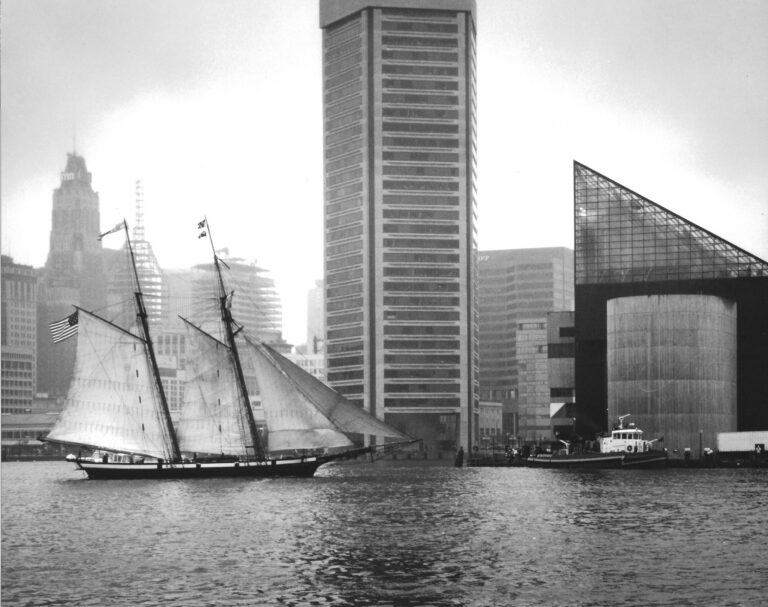
In the weeks that followed, stories about Pride continued appearing in newspapers from Frederick, Maryland, to New York City, in sailing magazines, and in countless publications. The reaction demonstrated just how deeply Pride of Baltimore had captured the hearts of people far beyond her home port.
On Friday, May 23, the United States Coast Guard announced that the search for the four missing sailors had been suspended. Over four days, ships and planes from the Coast Guard, Navy, Air Force, and Marine Corps had scoured more than 500,000 square miles of the Atlantic with no success.
That same day, hearings related to the federal investigation into the loss of Pride began at the Federal Custom House in downtown Baltimore. The official inquiry, conducted by the Coast Guard and National Transportation Safety Board, would conclude on May 30.
On June 1, Pride survivors, family members, former crew, politicians, friends, and supporters gathered at Fort McHenry for a memorial service. The service would be covered in the following day’s Washington Post, with headlines reading, “1,300 Pay Tribute to a ‘Floating Bit of Baltimore.’” Later estimates placed the crowd closer to 1,500 people who gathered at the fort to “remember, with tears, prayers, and even a bit of wistful make-believe, the historic schooner and four of her crew.”
Applause greeted the eight survivors. Speakers at the ceremony included crew survivor John “Sugar” Flanagan and members of the board, joined by Governor Harry Hughes, Baltimore Mayor William Donald Schaefer, and businessman and board chairman William Beasman, who spoke about how the ship was a “floating bit of Baltimore,” beloved by those who longed for adventure.
In a letter read by Flanagan, Barry Duckworth’s father wrote that his son was “proud to have been selected to crew the Pride. He didn’t love to sail, he lived to sail.”
It was reported in news coverage of the memorial that another goodwill ship would be built. By that time, since the sinking, $150,000 in donations had been contributed toward a new vessel. Plans were also developing to construct a memorial to the first Pride in the Inner Harbor.
Coverage of the loss of Pride, the subsequent investigation, and updates from survivors continued appearing in newspapers and publications well into the summer of 1986. Alongside that coverage, calls for a new ship began appearing in local press.
While donations had already poured in following news of the tragedy, there was no rush to make a decision. But in an editorial in a Cumberland, Maryland, newspaper, one writer captured a sentiment shared across the state:
“We in Western Maryland, and most certainly the rest of the state, were proud of the clipper ship that had Baltimore’s Harborplace as its home berth, and we were deeply saddened when this symbol of Maryland sank.”
The editorial continued:
“A suggestion to the backers of the Pride of Baltimore. This time extend participation in the venture to all Marylanders, for they suffered the loss of the Pride as much as Baltimoreans. The state needs this symbol.”
In addition to the almost constant coverage in the press, behind the scenes hundreds of letters, notes, cards, flowers, and even telegrams were sent to Pride’s office in the World Trade Center in Baltimore.
From beautiful stationery and corporate letterhead to handwritten cards, hundreds upon hundreds of pieces of mail poured in, many including spontaneous donations.
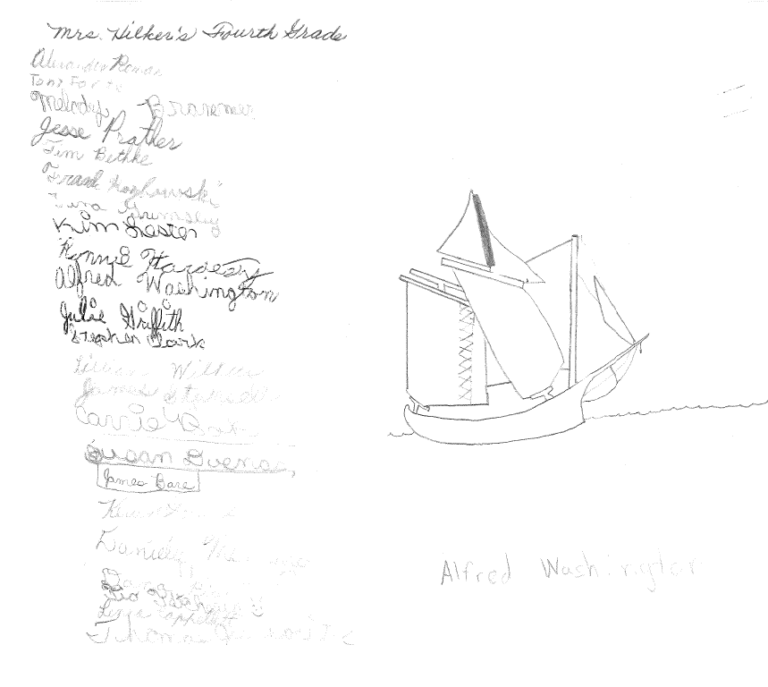
One such card came from Mrs. Hilker’s fourth grade class at Deerfield Elementary School in Edgewood, Maryland. It read, “The Pride and her crew will be etched in our memories forever,” and featured a drawing of a schooner by student Alfred Washington, the card was signed by the entire class.
Letters of condolence came from across the ocean, from embassies, mayors, business leaders, and law firms, they came from anywhere the ship visited and hosted receptions and tours. Remarkably they even came from ports not called on, people and places not visited by the ship still reached out. From Livorno, Italy—a port Pride would never make it to—yet even there, news of the loss saddened people. The letter came from Maria Gloria Giani of the Italian company Pilade Giani. Another arrived from L. Dewerdt, First Deputy Mayor of Dunkirk, who noted:
“I knew that fine ship since my first visit to Baltimore in 1980 … As many of your citizens, I was in love with her and I was terribly shocked when I learned she had gone down.”
Of course hundreds (perhaps more) came from closer to home, former crew, and friends of the ship including one from Pride’s sailmaker, Nat Wilson. One from John W. Snow, then President and CEO of Rail Transport Group of CSX Transportation, his letter was accompanied with a check to be used for a memorial for this “fine symbol of the city’s heritage.” One particularly moving letter came from Elizabeth Bruen of Baltimore, who wrote:
“I regret not telling you before this how much your efforts over the past 10 years were appreciated. What joy the Pride brought to all of us. The enclosed check is to help build a memorial to her and her crew. Please keep me informed of your plans for a new vessel. I will want to contribute to that effort from the beginning.”
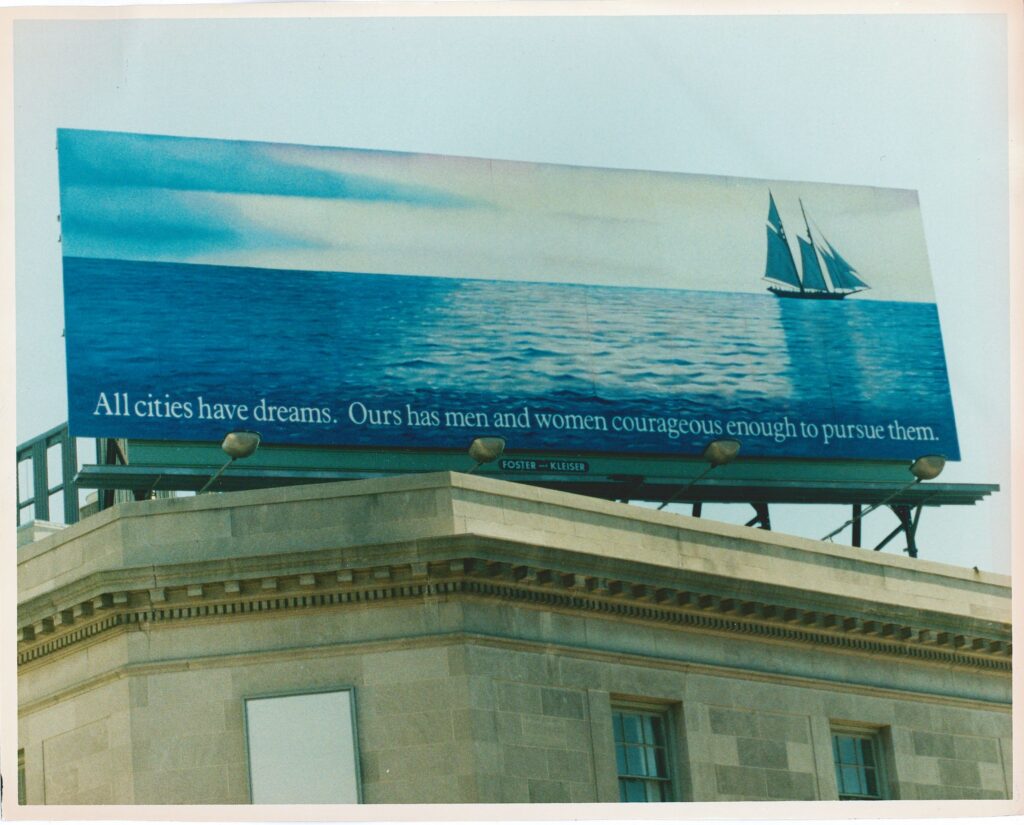
We will end this blog with one more incredible item from our archives that we think perfectly captures the profound impact Pride had on Baltimore. In early June of 1986, the billboard at Charles Street and North Avenue would be dedicated to the memory of Pride of Baltimore. It was a simple yet powerful design, a photo of Pride sailing in calm waters, almost out of frame, at the bottom a quote,
“All cities have dreams. Ours has men and women courageous enough to pursue them.”
I hope you are enjoying our ongoing 50 Years of Pride series.
As we reflect on the loss of the original Pride of Baltimore, we are reminded not only of the tragedy itself, but of the extraordinary outpouring of support, remembrance, and resolve that followed in its wake. Thank you for taking the time to read and remember alongside us. In the weeks ahead, we will continue sharing more stories, memories, and history from Pride’s legacy as we honor the people, purpose, and spirit that continue to sail forward today aboard Pride of Baltimore II.
Cheers,
Patrick
Bibliography:
Waldron, Tom. Pride of the Sea. Citadel Press, New York, NY, 2004.
Spolar, Chris. “1300 Pay Tribute to a ‘Floating Bit of Baltimore.’” The Washington Post, June 2, 1986.
“Let All State Take Part in New Ship.” Cumberland News (Cumberland, MD), July 7, 1986, editorial.
“Pride Crew Remembered at Service.” The Salisbury Times, June 2, 1986.