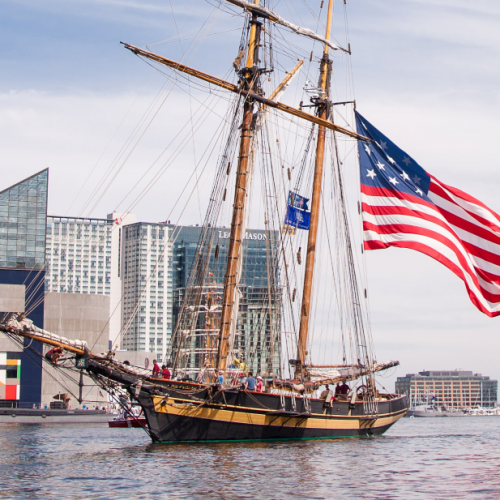
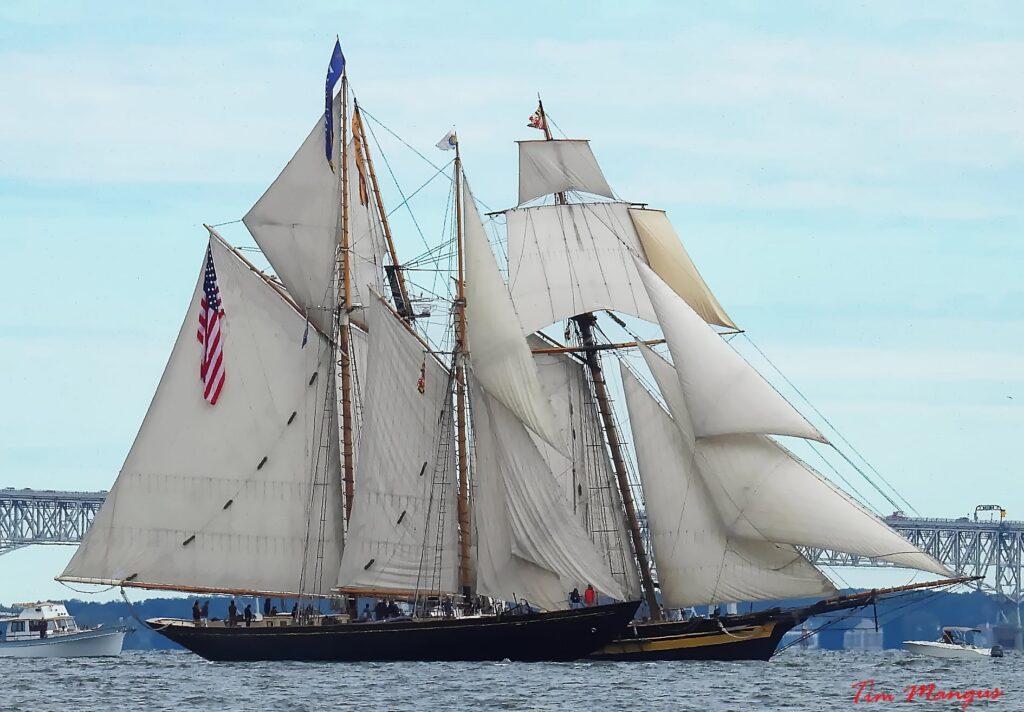
The wind was actually dead calm for a significant period of time. Forcing the decision to shorten the courses for the different classes.
The start had some breeze. Upwards of 10 knots. Which provided adequate wind power to the fleet to achieve decent starts.
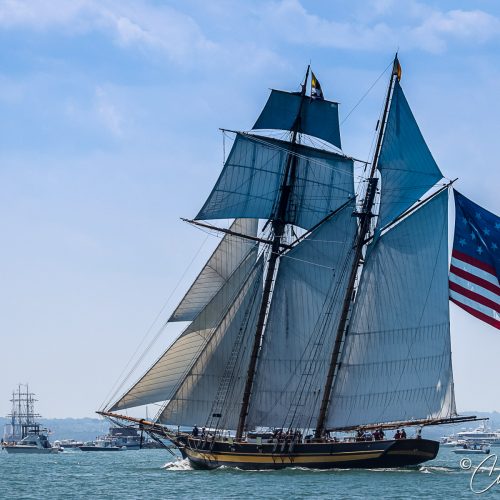
The first of the classes to start were AA and A at 12:10 PM Thursday. These are the historical reproduction type vessels and the faster more modern 20th Century classic yacht type vessels.
A nicely long “reaching” starting line provided plenty of length for the longer vessels to get to their desired positions along that line and gain clear wind without having to be bothered by any of their competitors.
Curiously, 6-7 minutes before the starting gun, Virginia chose to take time to force Pride away from her somewhat downwind approach toward the windward “pin end” of the starting line. Effectively directing both vessels across the start line around 5 minutes before the starting gun.
This was accomplished by sailing Virginia directly at Pride’s lee bow to achieve an “overlap” of Virginia’s bow to the lee side Pride’s stern. Anti-Collision Rules of the Road for sailing vessels sailing on the same tack, in this instance the PORT tack, require the windward vessel, in this situation Pride, to steer clear of the approaching leeward sail vessel. Sail Vessel Racing rules adjust this anti-collision “safety” rule to specifically and expressly allow an overtaking leeward vessel that actually achieves an overlap of the stern of the windward vessel, to force the windward vessel being overtaken to steer further away as the lee vessel continues to steer closer. Evan allowing to force steering all the way to windward. However, in this reaching start line situation, Virginia did not have the time to keep forcing Pride to windward, given the start gun was less than five minutes away.
Pride responded to the overlap achieved by Virginia by turning away from her. As Virginia came close to Pride she lost her wind power in the wind shadow Pride created. Both vessels passed the pin end of the starting line, affectively crossing the line early by around five minutes.
During this maneuver, Virginia lost speed. As Pride pulled ahead both vessels were faced with turning downwind and gybing back towards the starting line. The goal being to get back across the line before reverse turning downwind again, another gybe, to properly cross the starting line as soon as possible after the official starting time. Gybing Pride is a pretty intensive process for her crew. They managed the extra demand wonderfully. Pride crossed the starting line well ahead of Virginia.
However, sadly, Pride gave up her lead through passing a “down race reaching mark” on the wrong side. Purpose of this reaching mark is to reduce clustering of vessels at one end of the line. Somehow I misunderstood which side. To correct this error Pride turned a full 360 turn to clear the error. Virginia passed Pride during this turn and remained ahead of Pride for the rest of the race. Final results being Virginia First in Class AA. Pride of Baltimore II Second in Class AA.
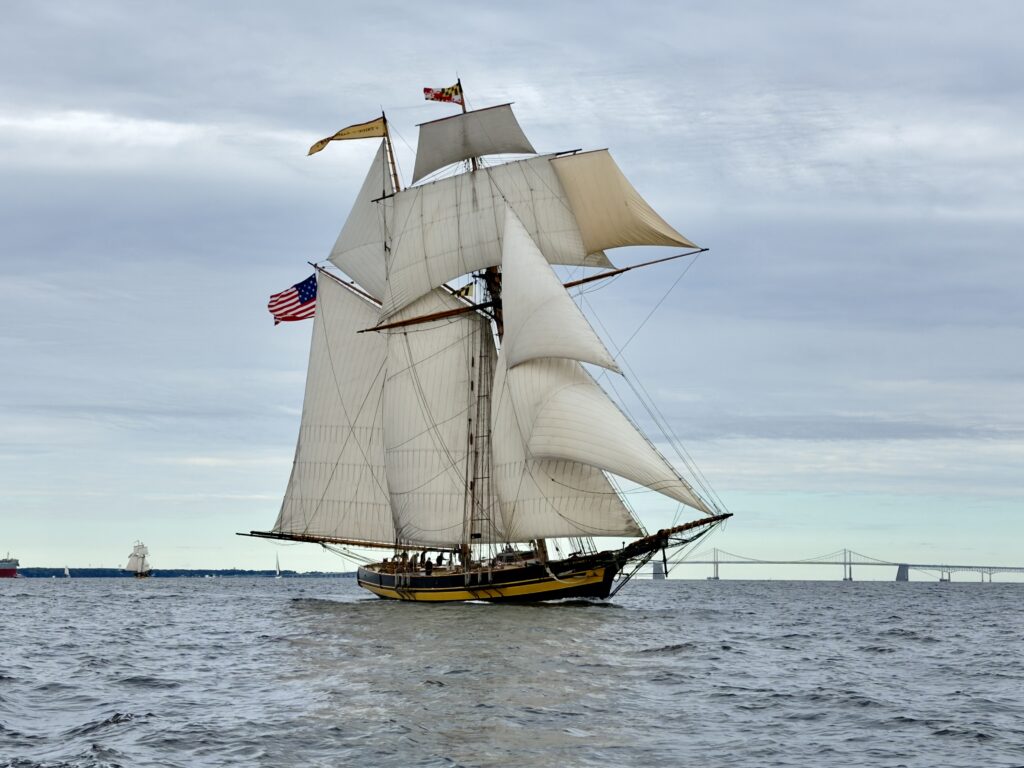
There were a few times Pride appeared to be catching up to Virginia. Only when there was more than 6 knots of beam reach wind. For less than 6 knots of beam reach Pride’s two feet of greater beam than is Virginia’s means slower acceleration than Virginia. During the softening wind, there were light wind pulses that Virginia was able to respond to while Pride did not. Eventually Virginia’s lead of around one nautical mile, after Pride’s 360 turn, extended to more than five miles at the foreshortened race finish line of Smith Point, Virginia marking the southern side of the mouth of the Potomac River. Instead of the normal finish line of Thimble Shoals Light all the way at the southern end of Chesapeake Bay.
The last six hours of racing leading up to a near dawn’s early light finish Friday, provided new wind from the southwest at around 10 knots. Both vessels sailed equally close-hauled to windward making between 5-7+ knots. Again Virginia’s narrower beam by two feet helped her sail faster. Pride crossed about 48 minutes after Virginia.
This windward sailing was such a nice relief from the near calm race winds, both vessels continued to sail well into Friday afternoon. Eventually, given there would be no extra points or bragging credits for sailing all the way to Thimble Light Finish Line, likely taking long enough that mooring in Norfolk before midnight was unlikely, both vessels switched to motoring in the afternoon. Stowing away sails, and getting moored before 9 PM. Also well ahead of the approaching cold front that arrived soon after midnight.
Saturday was a very rainy day. However, the after race party was, as usual, well thought out. Tents provided shelter. There was plenty of warm food, including oysters and clams. The awards ceremony was full of humor and good cheer. Another testament to the community spirit of the Great Chesapeake Bay Schooner Race that has spanned more than three and a half decades. A dramatic celebration of the wonder of the Chesapeake Bay. Both Pride and Virginia are two of its “queens,” representing the two states that bound the Bay. And are clearly benefited by the Bay.
Signed,
Jan C. Miles, Senior Captain