Dear friends and fans,
For this edition of 50 Years of Pride, we’re opening the archives to explore three objects with connections to Pride‘s history and the wider maritime community. From a longtime Great Chesapeake Bay Schooner Race tradition to bells cast during the construction of Pride of Baltimore II and a gift from the original Pride‘s visit to California, these objects each have a story to tell.
The stories in this edition draw on information generously shared by Captains Jan Miles and Peter Boudreau, as well as Shipyard Construction Foreman, Leroy Surosky, and historical newspaper coverage preserved in Pride’s archives, including articles from The Stockton Record.
A Clock
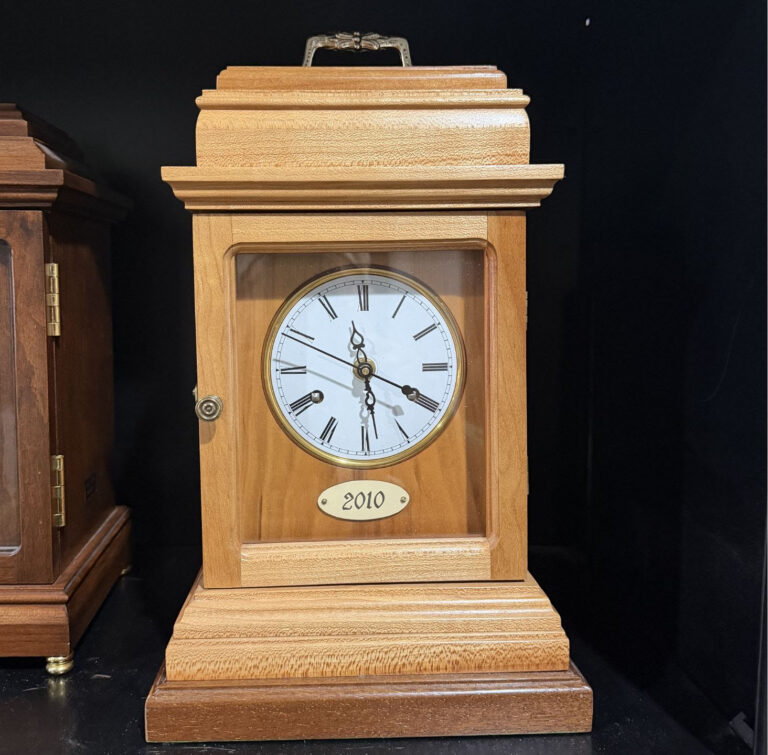
One of the most coveted trophies at the Great Chesapeake Bay Schooner Race is awarded to the first schooner to cross the finish line at Thimble Shoals, earning the distinction known in sailing as line honors. The trophy is a clock, now known as the Robert Latimer Award. For many years, the handcrafted wooden clocks were built by the late Bob Latimer. Following his passing, Captain Michael Fiorentino took on the responsibility of crafting the award, ensuring the tradition continued in Latimer’s name. Pride of Baltimore II has brought home six of these clocks over the years.
The first resides in Pride II’s aft cabin, four more from 2006, 2008, 2009, and 2010 are in our office, and the latest, won in 2025 under Captain Jeff Crosby, resides in his office on Clinton Street.
We chose the 2010 clock to highlight because Latimer built it using wood from the construction of the schooner Virginia, creating a wonderful connection between two storied vessels of the Great Chesapeake Bay Schooner Race.
The 2025 clock carries a special dedication to Michael Oh, a beloved member of the Baltimore and Chesapeake Bay sailing community who passed away earlier that year. In keeping with Mike’s playful spirit and love of humor and street art, the back of the clock features a pair of googly eyes. Friends and family were encouraged to add googly eyes to everyday objects to celebrate his memory, bringing a little life and joy to the ordinary. What better place to keep that tradition going than on a handcrafted trophy celebrating a race and the community behind it?
A Bell
For centuries, bells have played an essential role aboard naval and merchant vessels around the world. Used for signaling, marking time, and sounding alarms, they were central to a ship’s daily routine and readiness throughout the age of sail and beyond. Beyond their practical and ceremonial purposes, a ship’s bell often becomes part of its identity, a familiar symbol of a vessel.
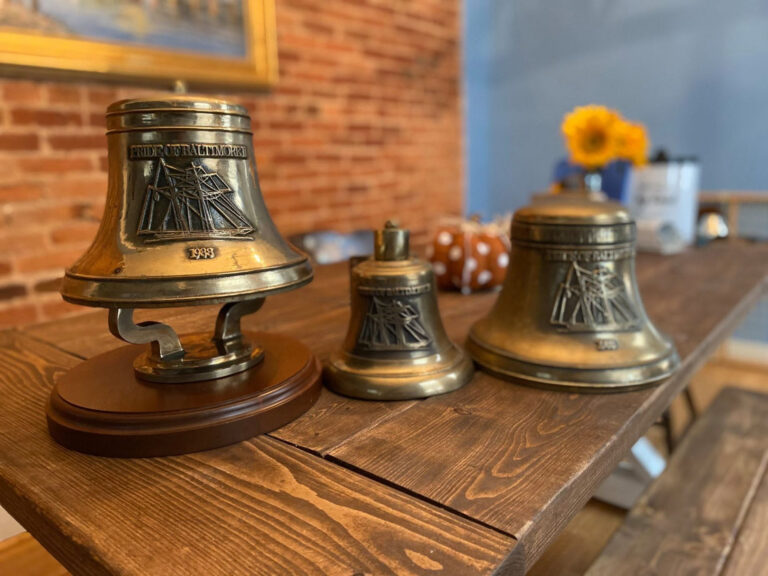
When Pride of Baltimore II was being built, shipwright Peter Boudreau worked with Stuart Walman of the McShane Bell Company in Glen Burnie, Maryland, to commission a bell for the ship. Two designs were cast, one went aboard Pride II, the other, an alternate design was was later given to Peter in recognition of his contributions as shipwright.
Casting extra bells was part of the process, so additional copies of both designs were made, along with a smaller, 10-pound version. In 2020, Stuart donated three of these bells to Pride inc.,: two 20-pound bells matching the original designs and a smaller bell, which is now on display at Eastport Yacht Club, celebrating the partnership and friendship between the club and Pride.
Together, these bells connect the craftsmanship behind Pride of Baltimore II to the people who helped bring her to life and the enduring relationships she continues to inspire.
There’s another local connection, too. The McShane Bell Company specializes in church bells, and we’ve heard the estimate that the company cast roughly 75 percent of America’s church bells. Its maritime connections are impressive as well. In addition to Pride of Baltimore II, McShane bells are carried aboard the SS John W. Brown, Lady Maryland, and Sigsbee.
A Key
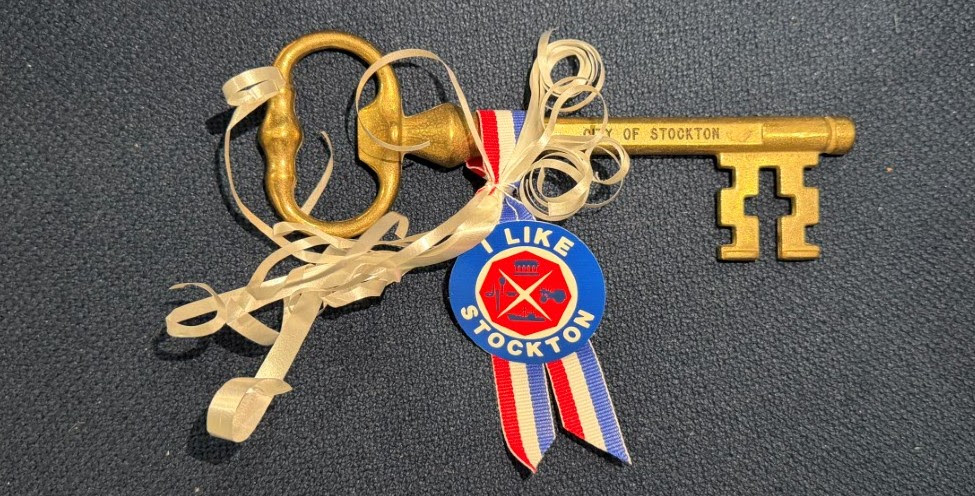
In August 1983, the original Pride of Baltimore arrived in Stockton, California, as part of a greater 17,000-mile voyage to the West Coast and back to Baltimore. It was the first such voyage for a Baltimore Clipper, and the ship’s arrival was met with a welcome that made quite an impression on the city.
The visit began on August 24, when Pride entered the Port of Stockton accompanied by scores of local pleasure boats. The local sailing club fired a four-cannon salute, a U.S. Navy fireboat sent up a watery welcome, and naval personnel and employees lined the docks of Rough and Ready Island, waving as the ship came in. The Navy band from Treasure Island played “California, Here I Come,” and Pride answered by firing all four of her cannons.
Stockton Mayor Arnold Rue presented Captain Jan Miles with the Key to the City. The crew was also honored the following day at a luncheon hosted by the Commercial Exchange Club, and the ship welcomed visitors aboard for free deck tours throughout her stay, which ran from August 24 through 28.
The August 25 edition of The Stockton Record offered a vivid portrait of the ship and her captain. It described Captain Miles as a red-bearded, six-foot-four, barefoot modern-day Viking. That at just 32 years old, he spoke with “quiet pride” about the vessel and her remarkable voyage. He also made an important distinction between the small, fast Baltimore Clippers used as privateers during the War of 1812 and the much larger clipper ships that carried fortune seekers and supplies to California during the Gold Rush.
Perhaps the best sense of the welcome Pride received comes from an editorial published on August 25, titled “The Pride of Stockton; the Pride of Baltimore.” The editorial opened with a description of the day:
Yesterday was one of those days when Stockton is unrivaled. A day when the world seems painted in water colors, soft pastels of greens and blues and yellow with an occasional muted red … It was a perfect day for boat watching.
The arrival also evoked memories of the men and women who sailed around Cape Horn during the Gold Rush aboard sailing ships. For Stockton, the visit brought a piece of maritime history to its own waterfront. For Baltimore, it was an opportunity to share its story with an audience thousands of miles from home.
The editorial praised the welcome given to Pride, noting that Baltimore was winning friends through the ship and its recreation of history. It suggested that it was perhaps unfortunate Stockton could not package up the pride of its own city and send it on tour. But the writer followed with a more lasting observation:
The pride of Stockton is not a thing. The pride of Stockton is its people and their history.
That sentiment speaks to the purpose of the original Pride of Baltimore. The ship carried Baltimore’s history beyond its own waterfront, introducing people across the country and around the world to the city’s maritime heritage. In Stockton, that mission found a kindred spirit in a city that understood the value of its own history and the people who shaped it.
When Pride was commissioned at her launch, Baltimore Mayor William Donald Schaefer made that mission official in the ship’s first log entry:
I, William Donald Schaefer, Mayor of the City of Baltimore, do hereby officially commission the ship Pride of Baltimore and call upon her and her crew to represent Baltimore and its citizens. Godspeed and may your voyage be a safe and prosperous one.
The Key to the City in our archives represents the warm welcome Pride received in Stockton and the connection forged between two port cities in August 1983. It is a reminder of the original ship’s remarkable voyage to the West Coast, and of the people and history that gave her purpose.
Today, Pride of Baltimore II continues that legacy, carrying Baltimore’s maritime history and the stories of its people to ports near and far, building connections through our shared history.
I hope you are enjoying our ongoing 50 Years of Pride series.
Stay tuned for part 23!
Cheers,
Patrick